

The information in this newsletter is being distributed among allied associations that form the California Alliance for Golf (CAG), the organization that speaks with one voice in the Capitol regarding legislative and regulatory issues of statewide scope.
As the Assembly and Senate finish determining which of the thousands of bills that were introduced in the 2026 session pass over to the other house to determine which among them make it to the Governor’s desk for his signature or veto, it’s a good time to take stock of how golf is faring.
Simply put, the 2026 legislative session is shaping up to be the best one for the California golf community in a long time. Some of the types of problematic issues we have had to deal with in the recent past – e.g., independent contracting, neonicotinoids, glyphosate, bans on non-organics in the Coastal Zone, and onerous workplace regulations of various kinds – didn’t come across our bows this year. We even saw some movement toward pre-empting local governments’ ability to ban the use of SORE; current legislation merely bans its sale.
We are still a few minutes short of halftime, but the three (3) bills CAG has been most interested in, and in each case for a different reason, the verdicts are in, and the news couldn’t be better.
The bill we are sponsoring in this session, AB 1954 (Ward; D-San Diego), a bill that would make it an unlawful business practice to broker municipal tee times without a written agreement from the owner or operator of a publicly owned golf course (roughly ¼ of those in the state), passed out of the Assembly on a 70-0 vote. It is now in the Senate, where it will be heard by that house’s new Privacy, Consumer Affairs, and Digital Protection Committee (Chair Christopher Cabaldon; D-Sacramento Delta). It may be double referred to the Judiciary Committee (Chair Tom Umberg; D-Santa Ana), but we won’t know that until the Senate Rules Committee issues its formal referrals. AB 1954 author Chris Ward (D-San Diego) plans to issue a small amendment when it is referred – an amendment with which CAG is in complete agreement.
The bill we viscerally opposed in this session, SB 1197 (Niello; R-Roseville), a bill that would eliminate Daylight Saving Time in favor of permanent Standard Time, is now dead. It failed to escape the Appropriations Suspense file. The same happened last year. Given just how critical this year’s staff analysis of the bill was, we will be curious to see whether the sponsors of the bill make another run in 2027. My guess is yes. While their cause is woefully unpopular and there is as much if not more science on the subject that supports a preference for permanent Daylight Saving Time, they are true believers in their cause. Interestingly, since the bill died, a bill was filed in the United States House of Representatives that would preempt California and the other states from choosing between Standard and Daylight Saving Time by taking the entire nation to permanent Daylight Saving Time. Such a bill (“Sunshine Act”) has come up in the Senate in the past, but this would be the first time that both houses of Congress have taken up the notion of permanent Daylight Saving Time. Because President Trump has now endorsed that position, maybe we won’t see another run of permanent standard time in California. Then again, Congress doesn’t pass much legislation these days. Stay tuned.
A bill we stayed off of but were viscerally interested in was AB 1603 (Schulz; D-Burbank), a bill that would commencing 2030 prohibit a person from using a pesticide that contains, and a person or entity from manufacturing, selling, delivering, holding, or offering for sale in commerce any pesticide that contains, any of the specified PFAS that are intentionally added as active or inert ingredients, and commencing 2035, prohibit those actions for pesticides that contain PFAS that are intentionally added as active or inert ingredients. Violations of AB 1603’s proscriptions would be crimes, not just civil violations. We stayed off the bill because of intelligence that informed us that the bill would be restricted to agriculture, as the whole PFAS movement is aimed mostly at the way in which these “forever chemicals” end up in the food we consume. That proved to be correct. AB 1603 passed out of the Assembly with a number of amendments, among them this restriction to agriculture. Notwithstanding this restriction, golf will continue to track the whole PFAS saga, as we are only at the dawn of it. Anything called a “forever chemical” is something that is going to continue to be scrutinized in all of its uses, and by very definition of the problem – a “forever chemical” – the defense users of chemicals have so often successfully invoked to limit their regulation – that “residue does not in and of itself constitute risk” – strains credulity.
All in all, not bad. The bill we sponsored has moved to the Senate on a 70-0 vote. The bill we opposed died and is further clouded by the possibility of federal preemption. And the bill we watched in eager anticipation to see whether our judgment about its restrictions not applying to golf was accurate, turned out to be spot on. If the rest of the session yields the same in the Senate for AB 1954 and then Governor Newsom’s signature thereafter, the California golf community will have done something that we don’t think any other state golf alliance has done – sponsor a bill into law and make clear that advocacy is not just about swatting down bad ideas, bills, and regulations; it’s also about proactively using the organs of government to solve problems.
COLORADO BASIN
If you suspected that not all the news in this issue was going to be as positive as Sacramento at the half, you guessed right.
If you read these newsletters, you know all too well that a river basin that was over-allocated when the rights to it were first divvied up in 1922 has been yielding less and less water ever since – and at an accelerating pace since 2000. As the seven (7) states that have been part of the “Compact” since 1922 have approached the termination of current agreements/arrangements at the end of 2026, they have taken actions to forgo allotments to keep Lakes Mead and Powell above the levels required to generate electricity, most recently “actions” by the States of Arizona and California to forgo an additional 1.6 million acre-feet over the next 2 years to give the states more time to come to an agreement before the federal government imposes one upon them, something the federal government is loath to do but may have to do if the states cannot agree to a formula for sharing the pain of a hollowed out river basin.
In addition to the additional water left in Lakes Mead and Powell by Arizona and California the US Bureau of Reclamation has taken what it describes as a one-time emergency release of water from another reservoir in order to just keep Lake Powell at its current 24% of capacity. Before a recent and most welcome late spring storm in the Rockies, the federal government had estimated Lake Powell to drop to a record low 13% of capacity.
That is the situation faced by some 40 million Southwestern souls whose homes, businesses, farms, and yes, golf courses are at least in part dependent upon imports from the Colorado Basin to meet their needs.
That is the situation as we await what the federal government is now promising will be the release of a 10-year “framework” that will prescribe specific water reductions that will be reassessed every 2 years. That “framework” is to come out this summer. Given that the gap this “framework” needs to fill is somewhere between 3 and 4 million acre-feet, it is hard to see how the four (4) Upper Basin States (Colorado, Wyoming, Utah, and New Mexico) won’t have to join the three (3) Lower Basin States (Arizona, California, and Nevada) in ceding back some of the allocation that the current agreement “entitles” them to receive.
There have been so many twists, turns, and feints in this muti-party negotiation process that this may not be the last. As close as we are to the summer season in which the federal government has announced its intention to release the 10-year framework described immediately above, it would not surprise anyone to see another “turn” in this process. There are reasons for bromides like hard cases make bad law and crises make bad policy. Let’s hope that this combination of hard case, hard law, hard crisis, and hard reality yields something that if not perfect, works for those of us dependent upon some semblance of certainty, even if that certainty is not idyllic.
NATIONAL LINKS TRUST – DISTRICT OF COLUMBIA MUNICIPAL GOLF
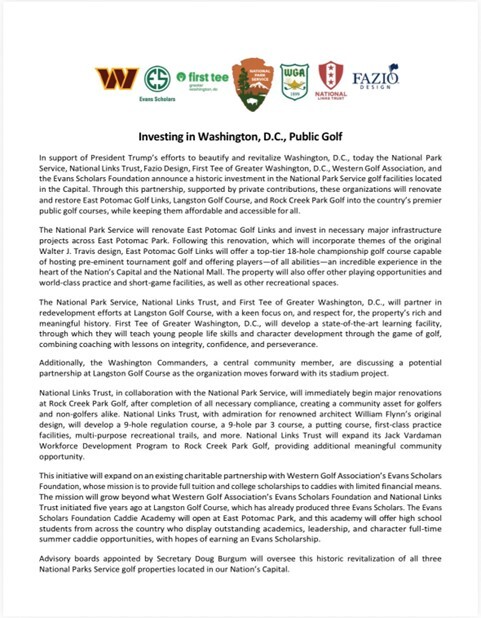
Below please read a statement put out earlier this month from National Links Trust (NLT) that brings a measure of closure to the ongoing dispute about the future of the three (3) municipal golf courses owned by the federal government, administered by the National Park Service, and operated by National Links Trust per a very long-term agreement executed between NLT and the Park Service as a result of an RFP process executed some six (6) years ago.
There is as much between the lines as there is in them. We are sure that those reading these lines will differ in their opinions of what this "measure of closure" means in terms of the future operation of the three affected municipal golf courses. We will leave you to your own opinions.
We trust that the many golf organizations that have consistently lauded the vision and work of NLT will continue to lend their support to NLT and NLT's work in Washington, D.C. and beyond. NLT has always aspired to carry out its work beyond these three golf courses, and maybe this new arrangement can give them the space to pursue those aspirations.
There is one other factor to consider, and it is the lawsuit that the group headed by Lanny Davis has filed challenging NOT anything having to do with the lease between NLT and the Park Service, but rather dealing with laws and regulations dealing with historical properties and environmental issues. Time will tell how that may affect the “closure” we suggest.
PARCEL TAX MOTION IN LOS ANGELES
Many of you have seen or heard of reports about a proposal by members of the Los Angeles City Council to place a parcel tax on private country clubs on the November ballot. The Council is working on a very aggressive timeline, with key votes scheduled for as soon as June 17.
Please know that the affected clubs as well as golf organizations are working in close coordination to address the matter. They and we are confident that the right persons with the right experience have been engaged to pursue a result that works for the clubs, the game, and the City of Los Angeles. Given the fluidity of the situation, anything we might share in a broadly distributed communication runs a high risk of misinforming.
More to come to be sure as developments warrant.