


The information in this newsletter is being distributed among allied associations that form the California Alliance for Golf (CAG), the organization that speaks with one voice in the Capitol regarding legislative and regulatory issues of statewide scope.
AB 1954 (PROTECTING ACCESS TO RESERVATIONS ACT)
ONE STEP AWAY FROM BECOMING LAW
Last Wednesday the Assembly concurred in the two (2) amendments to AB 1954 that were taken in the Senate, one of them of some substance that CAG very much favored and another of a purely technical nature that was suggested by the Attorney General (Department of Justice). With that vote the Assembly and the Senate have now passed identical versions of AB 1954, a bill that would put firmly into California law a prohibition on any "person or operator of a third-party golf reservation service platform from listing, advertising, promoting, selling, or transferring a golf course reservation for a golf course owned by a local agency without the written agreement of the course operator."
AB 1954, as it passed the Assembly per an amendment taken when the bill was heard in the Assembly Privacy Committee, exempted an individual who paid for the reservation from the bill’s prohibition, if the course operator did not offer refunds, which would have vitiated much of the benefit cities and counties have secured from the adoption of non-refundable deposit protocols. The Senate amendment deleted the condition that the operator does not offer refunds and, instead, applied the exemption if the operator fails to clearly post its cancellation policy on the internet website where the reservation is secured, a protocol that is routine in municipal golf and where it isn't practiced, ought to be practiced and will undoubtedly be practiced if the Governor signs the bill.
At the behest of the California Department of Justice, the initial Assembly version that specifically referenced the "Unfair Competition Law" was amended to eliminate a duplication that DOJ suggested could prove problematic for a municipal operator seeking redress under its provisions.
AB 1954 now goes to the Governor for signature or veto. The Governor has until September 30 to sign or veto all bills that are sent to that Office when the legislature ends its regular 2026 session at the end of August. While we have no reason to believe that the Governor will do anything other than sign the bill, we will certainly communicate with the Office to determine if there is any issue or problem we may have overlooked.
For those who may have thought that reservation policies such as non-refundable deposits and no-show penalties solved much of the problem that exploded in the Los Angeles and San Diego regions in 2024, we cite the wisdom contained in the City of Los Angeles’ formal AB 1954 support letter and a recent article in the National Golf Course Owners Association’s (NGCOA) “Golf Business Weekly,” a story we are informed will run as well in NGCOA’s next quarterly magazine.
First, the “wise” words in Los Angeles’ AB 1954 support letter:
“In April 2024, we implemented a non-refundable green fee deposit requirement at the time of booking. Fully funded by our golf patrons and designed to discourage speculative reservations, this measure has restored a measure of integrity and equitable access to our reservation system. However, relying solely on internal administrative measures to counter those seeking to profit from Los Angeles’ commitment to affordable, accessible public recreation is not a sustainable solution. Without stronger legal protections, these efforts remain vulnerable.”
“Not a sustainable solution” – governments understand that they are always at a disadvantage when trying to stay ahead of those that are technologically adept. Not to mention that according to that recent article in “NGCOA’s Golf Business Weekly” entitled, “Who’s Listing Your Tee Times,” there are scores of examples of 3rd parties operating without contractual agreements, using course names, logos, and photographs without licenses, advertising stale prices, and re-selling on secondary markets. As stated in the story:
“The bottom line: the technology itself isn't the problem. The problem is when it happens without your knowledge or consent, such as displaying filled tee times, incorrect rates, and using your brand assets without permission. A formal relationship — even an informal but documented one — turns the same technology from a liability into a legitimate sales channel.” [NGCOA Golf Business Weekly; Who’s Listing Your Tee Times – a Member Guide to Online Tee Time Agents, August 14, 2026]
And that is what AB 1954 aims to offer California’s operators of publicly-owned golf courses, roughly ¼ of the golf facilities in the state, – a tool to compel the “relationship” that can turn a “liability into a legitimate sales channel.” And a tool to protect municipalities’ ability to offer their parkland golf properties at price points consistent with their missions to provide active recreational opportunities to their residents on affordable/accessible bases.
A journey we began in October 2025 when we met in Sacramento with multiple parties to assess their appetites for what ultimately became AB 1954 is one last step away from the finish line.
Click Today's Law As Amended - AB-1954 Municipal golf courses: reservations. to read the bill as it will be enrolled in California’s Business & Professions Code if the Governor signs it into law.
Click https://www.ngcoa.org/golf-business-weekly/2026/august/week-1/whos-listing-your-tee-times. to read the full NGCOA Golf Business Weekly story.
COLORADO BASIN
IT JUST GETS WORSE
Lake Mead and Lake Powell are at their lowest levels ever – only 30 feet above what is necessary to generate electricity. The Colorado River is now yielding 32% less water than it did throughout the 20th Century. The National Oceanic and Atmospheric Administration reports that in July the United States suffered its hottest month in the 132 years the agency has been keeping records. And the costs of all forms of water are rising multiples atop a CPI that is already rising at uncomfortably high rates.
Against that backdrop, the federal government issued a plan July 31 for moving past the expiration of the long-term Colorado Basin allocation agreement at the end of 2026 NOT by issuing a long-term plan capable of providing some semblance of the stability necessary for water providers, businesses, cities and states to make their own long-term plans based thereon, but rather a 10-year operating agreement subject to significant change every two years, including what for the Lower Basin States (Arizona, California, and Nevada) could be as high as 40% cuts.
For the first two years, the US Bureau of Reclamation accepted a plan put forward by the Lower Basin States to reduce their allotments roughly 1.25 million acre-feet for the first two years instead of what could have otherwise been 3 million-acre-feet had the federal government moved immediately to implement 40% cuts. Because California is the holder of the most senior rights per the terms of the original 1922 Colorado Compact, it is giving up less (10%) of the allocation that would be its right under the “Law of the River” than either Arizona, which is ceding 27%, or Nevada, which is ceding 17%.
The four Upper Basin states, of which Colorado is the largest, are not being required to give up any of the water they currently pull from the Basin based on a theory that they have never used all of it during the life of the 104-year old Compact.
California can cope with taking 10% less over the next two years in large part because the state has developed local supplies to augment what it imports both from the Colorado Basin and the State Water Project. “Cope,” yes, but that doesn’t mean that California can relax. There will be impacts; Southern California cities get roughly 25% of their water from the Colorado River. And there is the matter of what two-year agreements mean in terms of the ability of California to plan beyond two years when the state doesn’t know when it might be faced with the worst case scenario embedded in the 10-year “framework” just promulgated by the federal government.
California has had a consistent record of ceding water back to the Basin as a river system that was over-allocated when its spoils were divvied up in 1922 continued to deteriorate under the hotter and drier conditions that took hold 30 years ago and have continued unabated since. California has also had a consistent record in never ceding any of its rights under American Law as the holder of all the senior rights to the water. “Never ceding” but also never going to court to invoke, preferring to work with the other six states in the Compact and the federal government to avoid the drawn-out litigation that most have long considered a worst case scenario.
Faced with a combination of deep cuts and the long-term uncertainty of what amounts to 2-year plans, Arizona’s reaction initially appeared to have crossed that proverbial Rubicon by issuing a very strong letter to the Trump Administration in advance of the plan’s formal release making clear its opposition to the 2/10 year arrangement and threatening to sue if it is implemented. From that letter:
“Arizona does not accept a framework that gives the federal government the discretion to select from a wide range of alternatives – including catastrophic cuts – every two years for the next decade.” (Source: Los Angeles Times; August 19)
However, just after the plan’s release, Arizona Director of Water Resources Tom Buschatzke characterized the plan to CNN as “a pretty good outcome.” Arizona’s two senators, Ruben Gallego and Mark Kelly, issued a joint statement in support of the plan. But Arizona Governor Katie Hobbs wrote in a post on X, "As long as I'm governor, Arizona will continue defending our right to our water by every legal means necessary and stand up to Upper Basin states who refuse to cut a drop of water in protection of the River." The apparent schism between the Governor and the rest may have something to do with Governor Hobbs facing re-election in November for an office she won four years ago by less than one percentage point. Or not. We don’t know. But what we do know is that there is no state in the Southwest facing a tougher road as things continue to deteriorate in the Basin than Arizona. And do keep in mind that Scottsdale, which is the heart of Arizona’s golf industry, relies on the Colorado River for 70% of its water.
Or perhaps not. On Monday, the State of Nevada filed the lawsuit Arizona merely teased. In announcing the suit Nevada Governor Joe Lombardo stated that “this isn’t about political posturing. This is a matter of survival for a community (Las Vegas) that represents about two-thirds of our state’s citizens and the lion’s share of the economy.” Las Vegas gets roughly 90% of its water from the Colorado River. The lawsuit, which prays for immediate declarative relief, argues that the Trump Administration’s plan violates the National Environmental Policy Act (NEPA), the Administrative Procedures Act, and the “Law of the River.”
While much of the Upper Colorado Basin, particularly the State of Colorado, endures its worst drought in history and is loath to voluntarily cede anything to a group of Lower Basin states that use the lion’s share of the water that originates in their region, Arizona teases a provision in the 1922 Compact that guarantees the Lower Basin states at least 7.5 million acre-feet per year from the upstream dams in the Upper Basin, and Nevada seeks declarative relief in Federal District Court to nix the plan entirely, the factor causing all of this upheaval isn’t getting better anytime soon – the reality that the Colorado Basin doesn’t generate enough water to meet the allocation formulae in place.
Add to that a growing cleavage between the four (4) states of the Upper Basin the three (3) states of the Lower Basin about the propriety of asking only the three Southern Basin states to cede their allocations, and it would not strain credulity to suggest that the situation is intractable. But it would strain what we have come to know about the capacity of impasses to dissolve once parties to them recognize that there is no alternative to finding common ground, no matter how slender or unpalatable that ground may be. So, we’ll see.
Mark Twain was more prescient than he knew when he quipped, “whisky is for drinking; water is for fighting.” And it’s a fight that the California golf community ignores at its peril. How the combatants ultimately reconcile the agreements and laws that govern the Colorado Basin with the realities of that Basin’s declining productivity will affect the golf communities in the Southwest immensely.
GOLF’S REVERSAL OF FORTUNE IN BELL GARDENS
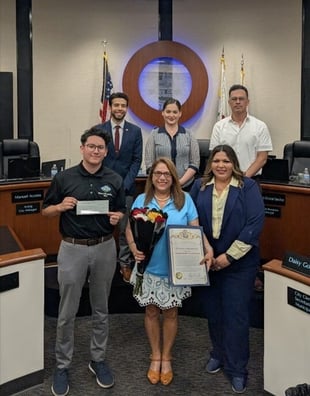
Latina Golfers’ president and founder Azucena Maldonado is honored by Bell Gardens Mayor Miguel De La Rosa, Mayor Pro Tempore Isabel Guillen, and Council Members Marco Barcena, Jorgel Chavez, and Dr. Francis De Leon Sanchez Honor Latina Golfers (Azucena Maldonado) at August 10 meeting proclaiming National Golf Month and recognizing the value the city’s 9-hole 3-par municipal golf course plays in the lives of Bell Gardens residents.
Azucena Maldonado and the Latina Golfers have been recognized many times and in many places for what they have done and continue to do for the cause of golf in general and the cause of women’s golf in specific. But this August night in Bell Gardens was different. It had a special poignance not shared by any of those other times and places.
You may remember the two runs of what the California golf community called the “Public Golf Endangerment Acts,” bills that would have offered substantial subsidies to municipalities and developers to transform municipal golf courses into housing complexes with a certain affordable quotient. But you may not remember that the Assemblymember who authored those bills hailed from Bell Gardens, and it was that city’s 9-hole 3-par golf course that the Assemblymember claimed was her inspiration for running the bills.
To the Assemblymember’s chagrin, she discovered that her colleagues from similarly situated working/middle class districts didn’t share her views about the value of affordable/accessible golf. The bills died – in large part due to the groundwork laid by organizations like Latina Golfers, the leadership of persons like Azucena Maldonado, and the guidance of organizations the SCGA and the California Alliance for Golf (CAG) that translated that grassroots groundwork into an effective legislative campaign in opposition.
During that Monday night meeting four of the five Council Members issued words about the value of golf and the golf course in their Bell Gardens Park, the city’s central park. The Mayor took up golf in college. Councilmember De Leon Sanchez is a member of the Latina Golfers. The two other members who spoke highly of golf and the city’s golf course spoke about wanting to take up the game.
What a difference a few years have made in this Southeast Los Angeles County city that sits on the other side of the San Gabriel River from Downey. From ground zero of an effort that would have caused havoc for the 22.3% of California’s golf courses that are publicly owned to a City Council meeting filled with praise and love for the game and the value it offers communities like Bell Gardens.
Not all reversals of fortune are about bad fortune. Some are about good fortune – and in this case the same kind of good fortune we have heard in recent months in places like Santa Ana, where their River View Municipal Golf Course, just three years ago the subject of conversion to a regional park, was recipient of the same kind of praiseworthy words heard in Bell Gardens and a 15-year lease agreement with a major management company replete with detailed plans for reinvestment in the facility.
Increasingly, we have been hearing versions of similar “good fortune” in other places in Southern California where not too long ago we were hearing plans for decommission. All thanks to organizations like Latina Golfers, champions of the game like Azucena Maldonado, golf enthusiasts like the Bell Gardens Girls Golf Team, devotees of the game who step forward to counter the game’s naysayers, elected leaders who understand the value golf brings to the constituencies they represent, and leadership organizations like the SCGA that devote some of their members’ dollars to assisting local communities in making their voices heard in the public space.
When those voices are heard, golf does all right. From the bottom up, not the top down – that’s the formula for these good nights in Council.
PROPOSAL TO CONVERT WOODLAND HILLS CC INTO 400 HOUSING UNITS HITS ROADBLOCK IN LA CITY COUNCIL
Woodland Hills Country Club was an equity country club for 80 years until the members decided to sell their shares to a private owner in a complicated arrangement in which those members could elect to secure non-equity memberships or simply sell out and move on. When the club opened in the 1920’s it stood practically alone in the far western edge of Los Angeles’ San Fernando Valley. Today, it sits just above the Warner Center, which as the downtown of the Western Valley, has been approved to add thousands of housing units per an expedited administrative process that was approved by the Los Angeles City Council as part of the Warner Center 2035 Specific Plan.
In other words, the new owner of Woodland Hills CC finds itself the owner of 93 acres of real estate that is worth infinitely more as housing than a golf club. So, the new owner decided to develop 20 of those acres into roughly 400 housing units, and because golf clubs in the City of Los Angeles are zoned A-1, which allows for agriculture, open/green space, and low density housing, the owner invoked AB 2011 to bypass the city’s normal processes for providing the Conditional Use Permit required to construct the hardscape elements of any housing project (e.g., streets and parking spaces/lots). AB 2011 is one of many laws passed in recent years to expedite the construction of housing by providing a faster ministerial approval process for multifamily housing projects located along certain commercial corridors.
Forgetting for the moment whether the parcel qualifies as a “commercial corridor,” it’s clear that In Los Angeles, parking is allowed in single-family zones with an approved conditional use permit. Because AB 2011 permits these projects on sites where parking is allowed as a principally permitted use — even if a CUP is required — projects can proceed in single-family zones.
Largely in response to widespread community opposition to the development plan, Councilmember Bob Blumenfield, in whose District the Woodland Hills CC sits, rallied 10 of his colleagues to support a motion directing the City Attorney and planning staff to prepare an ordinance that would amend the zoning code for what is known as A-1 zones to exclude vacant lots — in this case a golf course — to be redeveloped into projects unauthorized under the zoning code.
Mr. Blumenfield was also able to get his colleagues to support an interim control ordinance (ICO) that would prohibit approvals and permits for any demolition, building, use of land, grading and other applicable permits for public parking areas on parcels in A-1 zones that are near sensitive areas, such as very high fire severity zones and hillsides, a circumstance that describes many other private golf clubs/courses in the city.
The Department of City Planning is expected to produce the ICO and have it come before the council for a vote. If approved, the ICO would be in place for 45 days, with the possibility of being extended for a year.
Where all this ultimately lands is anybody’s guess. And we won’t venture a guess. We will only point out the following. Sixty years ago, when Los Angeles had roughly half the population it has today and a smaller percentage of that population played golf than plays the game today, the city was home to a large number of daily fee golf courses and stand-alone practice facilities. Today, Los Angeles is home to only two species of golf course – private golf clubs and publicly owned golf courses (municipal). And may well be down one private golf club if at the conclusion of the wrangling, Woodland Hills CC is chopped up for housing.
Whatever the issue – housing, commerce, taxes, water, greater public access – IT’S THE LAND, STUPID!